
Edutainment · 30 minutes
KeyTalk – Comedy Science with Jim&John
Teamwork as partner acrobatics — well-founded insights from science and experience. With fun facts, audience interaction and live demonstration on stage.
KeyTalk in 26 seconds (German, subtitled)
What keeps two acrobats in the air keeps your team together: counterweight, trust, shared laughter.
TRUSTED BY 500+ CLIENTS

Teamwork you can touch
Explain teamwork and you get nods. Show it and you get memories. Jim&John turn partner acrobatics into a metaphor for your employees' everyday work: where is a counterweight needed? When does trust carry, and when is agreement not enough? The two brothers add scientific fun facts, involve the audience and demonstrate the content live — edutainment in 30 minutes.
Three pillars of collaboration
Partner balance
Counterweight instead of uniformity: how two different people stay in balance together.
Fun Fact
A body only tips over when the plumb line through its centre of gravity leaves its base. Two partners share one common centre of gravity — whoever moves, shifts it for both.
Source: Physics: stability
Partner trust
Letting go because the other holds. Trust is not a mood but a technique.
Fun Fact
Google's team study “Project Aristotle” found: the most important factor for strong teams is psychological safety — knowing you can admit mistakes without fear of embarrassment.
Source: Google re:Work, Project Aristotle
Putting up with your partner 😂
Quirks, misunderstandings, bad days: why humour is the best lubricant of any collaboration.
Fun Fact
Laughing together raises pain tolerance: in studies, groups endured more after laughing than before — probably because endorphins are released, and they bond.
Source: Dunbar et al., 2012
Partner balance
Partner trust
Putting up with your partner
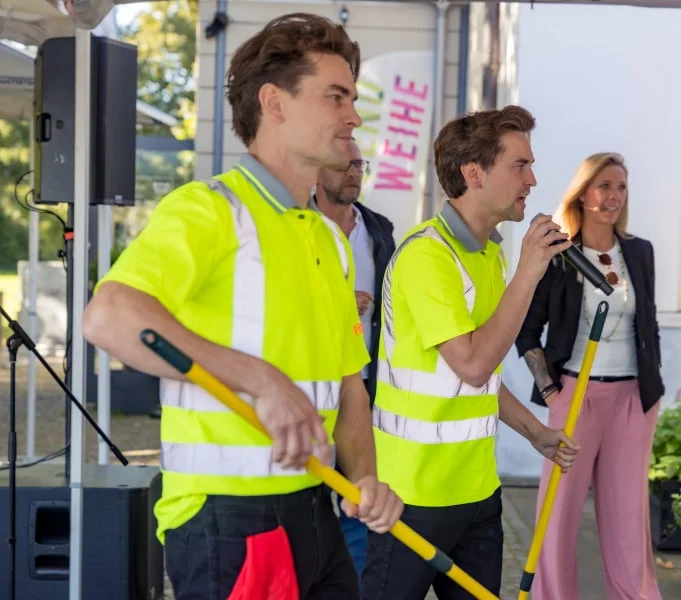

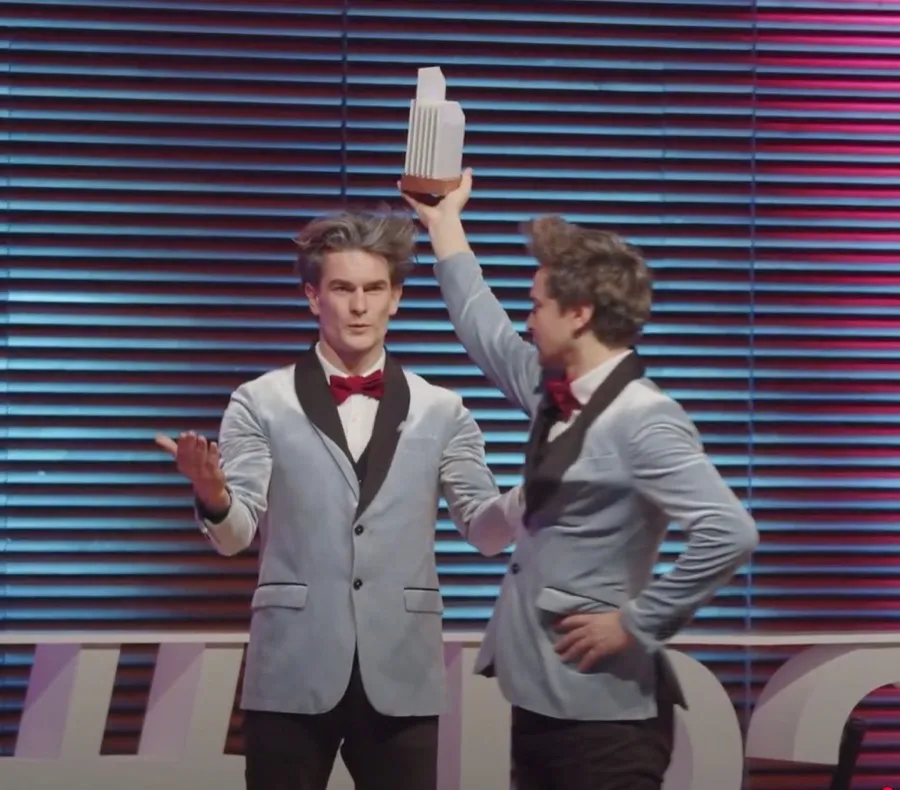

What's inside
Partner acrobatics as a metaphor
Trust, communication, counterweight: what keeps two artists in the air keeps your team together day to day.
Scientific fun facts
Physics, psychology and team research — served so you won't forget them.
Audience interaction
Your employees are not spectators but participants: guess along, join in, laugh along.
Live demonstration of the content
Every statement is shown on stage right away — not on a slide, but with two people on top of each other.
How a KeyTalk builds its 30 minutes
- 1Thesis
- 2Story
- 3Live proof
- 4Join in
- 5Take-away
In what form?
With edutainment training content, depending on the occasion as:
TED-talk style
One clear thesis, one story, one aha — with live proof.
Keynote speech
As opening or closing for a kick-off, conference or annual party.
Stand-up comedy duo hosting
Two brothers host your programme — with training content between the punchlines.
Optional extensions
The impulse becomes change — if you wish, we build on it:
The science behind the duo
Two people, one balance: a lift works because both partners are different and need each other. Research offers three building blocks that any team can use.
Difference is the norm. Even people who grow up in the same home differ markedly in personality. Plomin and Daniels showed in 1987 that each person brings an individual world of experience. For teams this means a mix of perspectives is a raw material, not an accident. Leaders who assign roles by strengths rather than by stereotype unlock that potential. Recent research agrees that blanket role labels ("the first leads, the last rebels") carry little weight.1
Safety creates performance. In 1999 Amy Edmondson studied 51 work teams: where people can speak openly, ask questions and report mistakes, the team learns faster. Google's "Project Aristotle" likewise names psychological safety as the most important factor behind successful teams. In acrobatics this is called trust: one partner lets go because the other catches.2
Rhythm emerges through coupling. In physics, two pendulum clocks on a shared support fall into step (Huygens 1665, rebuilt by Bennett et al. 2002). In neuroscience, joint action brings the brain activity of two people into alignment ("inter-brain synchrony"). The pattern repeats: those who respond to one another reliably find a shared beat.3
In the KeyTalk "Comedy Science", Jim & John make these building blocks tangible: with humour, live elements and takeaways your team can use the next day. Tuckman's team phases appear too: friction (storming) belongs on the road to peak performance.
Fun Fact 1
Two pendulum clocks on a movable beam settle into opposite swings — Huygens noted it in 1665, Bennett et al. confirmed it in 2002.
Fun Fact 2
Across 51 work teams, psychological safety predicted learning behaviour; team efficacy alone did not.
Fun Fact 3
Birth order explains little about personality: in panels from three countries with roughly 20,000 people, Big Five traits showed no effect.
A taster for your team: the Geschwisterhütte for teams — a hero's-journey game for two to five people, playable online. Trust, roles and rhythm to try out yourselves before the KeyTalk brings them on stage.
For a private evening: the Geschwisterhütte for home — family or friends solve the puzzles together. The same three building blocks, played at home rather than only at the office.
- Sources
- 1Plomin & Daniels (1987), Behavioral and Brain Sciences 10 · Rohrer, Egloff & Schmukle (2015), PNAS 112
- 2Edmondson (1999), Administrative Science Quarterly 44 · Google re:Work, „Project Aristotle“
- 3Bennett, Schatz, Rockwood & Wiesenfeld (2002), Proc. R. Soc. A 458 · Tuckman (1965), Psychological Bulletin 63
Who it is for
- Corporate events, team days & kick-offs (B2B)
- Seminars, conferences & training — as opener or moderation format
- Clubs, schools & groups
- Family celebrations & private occasions (B2C)
Price ranges for business clients: Pricing for business clients — net minimum rates per format, for business clients only.